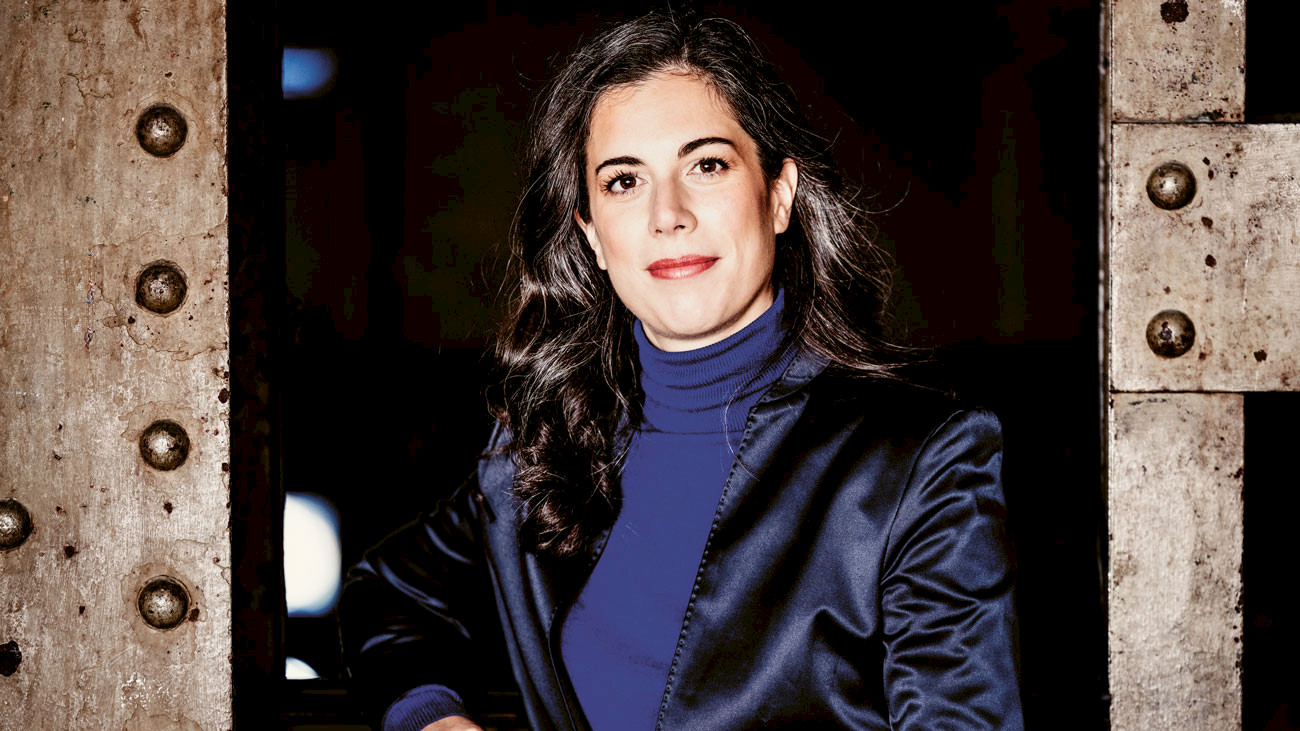
When you look at Marie Jacquot's career, you get the impression that she only knows one direction: upwards. However, her first career decision shows that her path was not always so clear. As a child, she set her sights on a career as a professional sportswoman; the now 36-year-old looks back: "As the youngest of three siblings, I was initially more attracted to tennis. Until tennis was no longer a game, but a battle against other people and against myself." In addition to competitive sport, music was also important in her family and upbringing. And her love for it grew naturally, partly because she rediscovered the joy of playing together. Marie Jacquot also had the kind of upbringing one would wish for children: "My parents were modest and took good care of us so that I could concentrate on my studies. I am infinitely grateful to them for that."
From the trombone to the baton
At the age of 19, Marie Jacquot would have liked to study trombone in Vienna. However, in her opinion, the way this instrument is played in France and Austria is just as different as the cooking traditions of these two countries. She failed the entrance exam. The trombone teacher who had to tell her this then added: "But I wish you good luck for the entrance exam for the conducting programme in a fortnight' time." No sooner said than done: Marie Jacquot's parents set off again a few days later on the twelve-hour car journey from Chartres to Vienna: This time it worked out, and she went on to complete her entire conducting degree at the University of Music and Performing Arts in Vienna.
Tennis, trombone: Marie Jacquot's life turned out differently early on, and she was open-minded and clever enough to make the best of it. This was also the case during her studies, when the budding conductor sensed an opportunity that had not yet materialised. Her fellow students who were studying composition presented their work every three months at the university. And although Marie Jacquot "hated" contemporary music, she saw conducting these new works as an opportunity to learn German and rehearse in German.
So again: she had a plan, off she went - and today she speaks German at a very high level. "I introduced myself to these young composers and said: 'If you need anything, I'm available'. And I was actually the only one in the five classes who offered to conduct new music. I was able to première almost 100 works. Since then, I've carried new music a little more in my heart." From then on, her professional career as a conductor quickly took off.
Ten years ago, Marie Jacquot received a call from Kirill Petrenko's assistant with the offer to assist him in the world premiere of Miroslav Srnka's "South Pole" at the Bavarian State Opera. At first she could hardly believe it. She accepted, even though she wasn't particularly fond of opera at the time. But she did: Seize opportunities when they arise. After this assistantship, she was offered two productions of her own at the Munich Opera Festival.
These positions followed: From 2016 to 2019, she was First Kapellmeister and Deputy General Music Director in Würzburg, followed by three years as Kapellmeister at the Deutsche Oper am Rhein Düsseldorf/ Duisburg. At the beginning of the 2023/24 season, she was appointed Principal Guest Conductor of the Vienna Symphony Orchestra, with whom she performed at the Bregenz Festival, the Vienna Konzerthaus and the Vienna Musikverein. In the summer of 2024, she also took on the position of Principal Conductor of the Royal Danish Theatre in Copenhagen - and from the coming 2026/27 season, she will become Principal Conductor of the WDR Symphony Orchestra, succeeding Christoph von Dohnányi, Semyon Bychkov, Jukka-Pekka Saraste and Cristian Măcelaru in Cologne.
People are the most important thing
Marie Jacquot now conducts operas and symphonic works throughout Europe, North America and Japan. When asked for this portrait which piece she will have conducted most often at the end of her life, she replies: "It would probably be the 'Alpine Symphony' by Richard Strauss. It always reminds me of how big nature is and how small we humans are in the universe. But as I'm directing more and more opera performances, it will hopefully be his 'Rosenkavalier'." In a radio programme on Deutschlandfunk in January, in which she described her journey in a lively yet down-to-earth way using selected compositions, she said of Strauss: "His music speaks to me because it tells so much about people. Their stories are close to us. I also feel very connected to German music and sometimes I have the feeling that I have a German soul." In interviews, Marie Jacquot repeatedly emphasises how much working with others means to her: "Music is about people and not about perfection, which you can never achieve anyway. People are always the most important thing for me. They are even more important to me than conducting."
Double debut
If there was one leitmotif in her career to date, Marie Jacquot says it would be to present unknown pieces. She will not be doing this with the Tonhalle-Orchester Zürich. On the contrary, the programme includes Modest Mussorgsky's "Pictures at an Exhibition" and Beethoven's Violin Concerto. She will be making her debut with this "world-class orchestra with high musical standards" and will also be working with Augustin Hadelich for the first time.
Things are likely to get colourful before these concerts: Marie Jacquot brings a small cloth bag with her when she travels to orchestras and opera houses. In it, she keeps a selection of dozens of coloured shoelaces. As a little pre-performance routine and to prepare herself for something special, she will choose the right colour for the concert and thread new shoelaces - and she will continue to do so after Zurich.