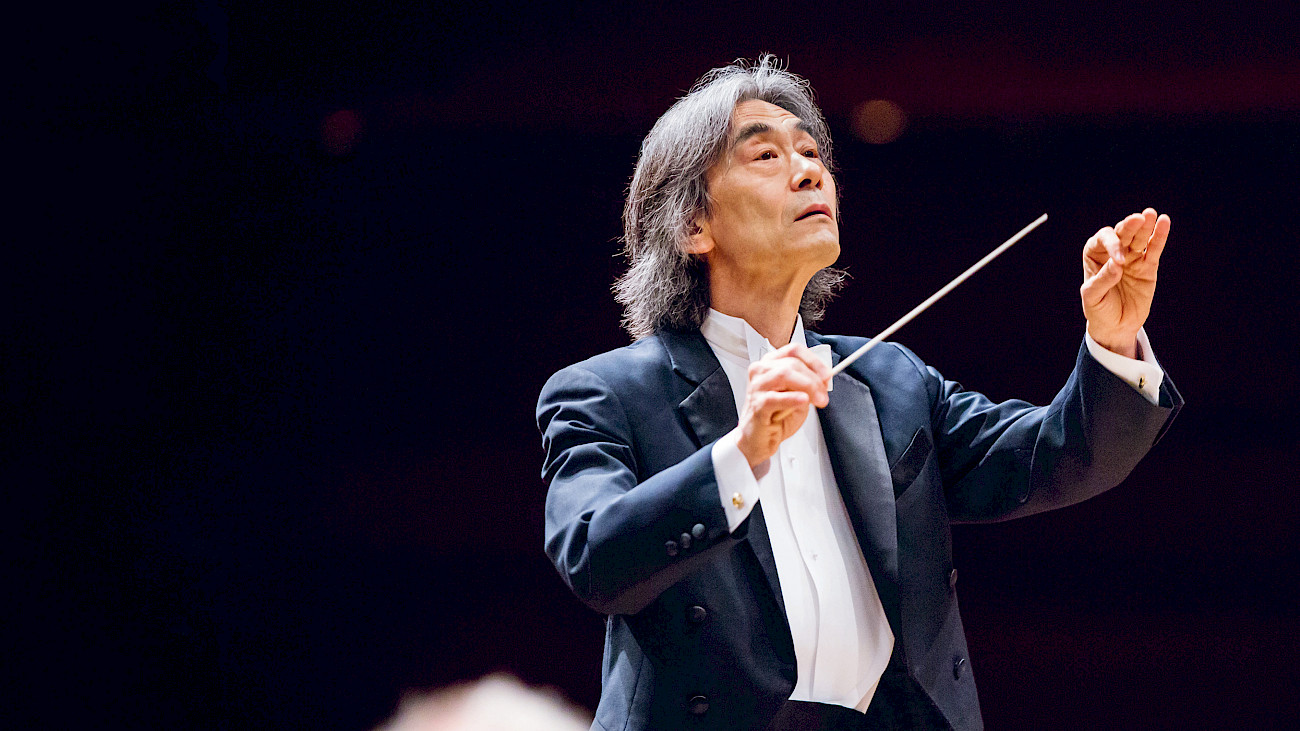
Kent Nagano (Foto: Antoine Saito)
Interview: Kent Nagano

"I see him as a father figure"

Kent Nagano conducts the "Turangalîla Symphony" by Olivier Messiaen. As a young musician, he lived with the composer and his wife Yvonne Loriod for a year.

Interview: Susanne Kübler

Kent Nagano, a performance of the "Turangalîla Symphony" is an event. The last time the Tonhalle-Orchester Zürich played it was in 2008. Is it something special for you too?

It's always something special and a privilege to be able to deal with a masterpiece! Great compositions remain an eternal challenge; they give both the audience and the performers the opportunity to hear and feel something new every time. Bach's "St Matthew Passion", for example, is one such work. And the "Turangalîla Symphony" also belongs in this category.

This symphony is also special for you because you knew Olivier Messiaen very well. What was he to you?

He was much more than a teacher or a professor who taught me important things. I see him as an artistic father figure. My whole view of music and my life changed because of him.

In what way?

I grew up on the American West Coast and started my musical education there as a child. It was very much influenced by the European tradition because 100 per cent of my teachers were immigrants and refugees. Nevertheless, the context of this learning was American culture. When Messiaen invited me to live in Paris with him and his wife Yvonne Loriod, I was completely separated from my American roots and forced to communicate exclusively in French. In this new environment I felt totally free, I absorbed everything I could - literature, theatre, art, music. But above all, I got to know the world in which the works I had studied were created. It was a revelation! Of course you can analyse and intellectually understand all aspects of a piece. But Messiaen gave me a cultural sensitivity.

Where did you live with him at the time?

He had a flat on Rue Marcadet in the 18th arrondissement, near Pigalle. It was a very modest neighbourhood. Messiaen moved into this flat block after the war and he stayed. Over the years, he needed more space - and so he bought additional flats whenever a neighbour moved out. When I came to Paris, he owned the whole fifth floor. But he never had passageways built between the flats. So if you wanted to move from the dining room to his study, for example, you had to go via the stairwell.

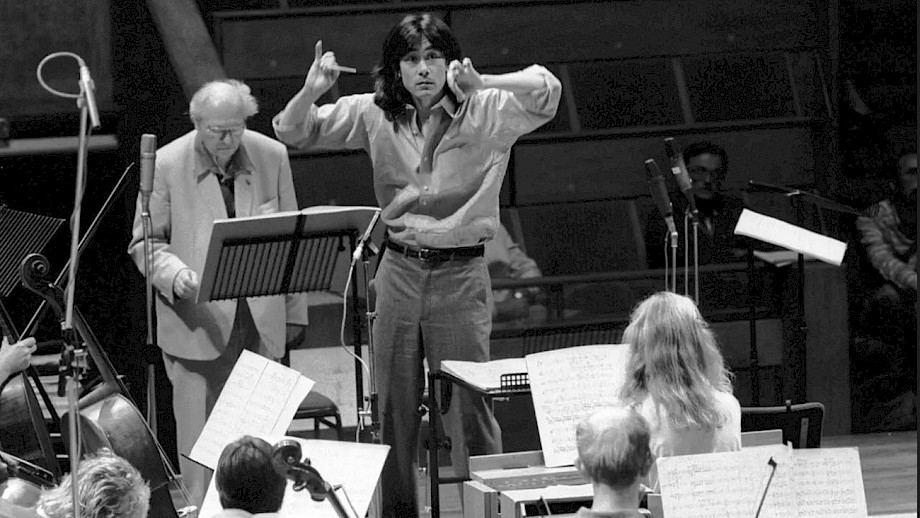
Olivier Messiaen and Kent Nagano at a rehearsal in Utrecht, 1986. (Photo: Co Broerse)

What was his life like?

He and Yvonne Loriod had a very open house at the time, it was a kind of meeting place. People from the art and music world were there almost every weekend, including politicians. I remember various visits from Karlheinz Stockhausen, Pierre Boulez and Betsy Jolas. Jacques Chirac, who was mayor of Paris at the time, sometimes came by accompanied by ambassadors or members of parliament.

Was it customary for Messiaen to take in young musicians?

He was enormously generous with his support. The conductors Zubin Mehta and Seiji Ozawa both told me how important his help was at the beginning of their careers. During my time with him, he also supported the composer George Benjamin and the pianist Pierre-Laurent Aimard. But as far as I know, I was the only one who had the privilege of living with him and Yvonne Loriod.

How did that come about?

I have to expand a little on that. At the beginning of my career, I was assistant conductor at Sarah Caldwell's Boston Opera Company. It wasn't a year-round job, we had two limited seasons in winter and spring. In between, I pursued my composition studies in Toronto or worked in my studio in Boston. Since I didn't have much of a budget, I spent most of my free time at the Boston Public Library. There are fantastic archives there, you can completely lose yourself in them for months! At some point, I stumbled across Messiaen's compositions purely by chance. I knew his organ works from my studies, and I had also come across individual orchestral works. But now I discovered his piano music, especially the "Catalogue d'oiseaux".

And what did you discover in it?

There were pieces in this cycle that not only pushed me to the limits technically, but which I also couldn't categorise theoretically. That was of course an enormous provocation for me! I then started to analyse each of these pieces and play them again and again. That took months, and it was often enormously frustrating. But I was persistent, and at some point I developed a relationship with this musical language. After that, I started analysing the orchestral works and was full of admiration for their brilliant depth and sophistication. It was a passionate endeavour that occupied me for around two years. I remember sometimes sitting in front of the score of the "Turangalîla Symphony" for up to 13 hours a day. To this day, my edition still contains all the pencil annotations from back then - the ancient Greek rhythms, the Indian deçî-tâlas, the modes with limited transposition possibilities ...

Kent Nagano

In 1982, the American conductor Kent Nagano (*1951) spent a year in Paris with Olivier Messiaen. The composer had a profound musical influence on him, and Nagano's relationship with the Paris Opera began with his work on Messiaen's opera "Saint François d'Assise" - this was the start of his international career. This led him to leading positions at the Opéra National de Lyon, Los Angeles Opera, the Deutsches Symphonie-Orchester Berlin, the Orchestre symphonique de Montréal, the Bavarian and Hamburg State Operas and the Hamburg Philharmonic State Orchestra. In September 2026, he will take over the Orquesta Nacional de España in Madrid. He is also an internationally sought-after guest conductor for classical and contemporary works in both concert and opera. He first conducted the Tonhalle Orchestra Zurich in 1999.

When did you perform a Messiaen work for the first time?

After the two years in Boston, I got my first full-time job as chief conductor in Berkeley, where I immediately planned a seven-part Messiaen cycle. During the preparation for the first work - "Poèmes pour Mi" - I searched half of North America for someone I could ask for advice on interpretation. I found a few who could say something about the theory or the technique of conducting something like this. Neither was of any use to me. What I needed was a deeper understanding of the style, the texture and the colours in Messiaen's music, and above all the philosophy behind it, the spiritual content. But I couldn't find anyone there. So I did this performance as best I could. Afterwards I put the radio recording - with the courage of desperation - in an envelope, together with a letter in terrible French, in which I asked Messiaen for critical comments. As I had no address, I simply sent the whole thing to "Professeur Messiaen, Conservatoire de Paris, France".

And he replied.

To my great surprise: Yes! Six weeks later I received eight pages of notes, typed in single spacing. He thanked me very much for doing this cycle and then discussed my recording bar by bar: attention, the dynamics change here, please be more flexible here, the balance in the orchestra has to be this way and that way so that a certain colour comes into its own ... It was really enormously detailed. And he asked me to send him the recording of the second work as well, which was the "Sept Haïkaï". I tried to take all his comments into account - then the answer came relatively quickly, and there were only three pages left. With the third piece, there were still two comments. Then came the "Turangalîla Symphony", and he wrote me that he had no more comments - but he would like to hear my work live. The next work on my list was the oratorio "La Transfiguration de Notre Seigneur Jésus-Christ", and he would like to suggest his wife Yvonne Loriod for the piano part: "She knows my music well, and I think she would be acceptable to you." So the two of them came to Berkeley. That was the beginning of our relationship, which was immediately very intense and inspiring.

How did those first rehearsals together go?

We worked non-stop for ten days and really immersed ourselves in the music. Even away from the rehearsals, we sat around the piano, where Messiaen conveyed his ideas of flexibility, colour, texture, breath, dance and lyricism to us. For example, he understood flexibility to mean something completely different from what was required in the bel canto operas I was conducting at the time. To explain what he meant, we played works by Ravel and Debussy, as well as Wagner. Messiaen later wrote that he felt the presence of God in this work.

And how did you end up in Paris?

That was another year later, in 1982, when he invited me to prepare the premiere of his opera "Saint François d'Assise". This premiere was conducted by Seiji Ozawa, but he couldn't be there the whole time because of his other commitments. Messiaen wanted someone he could trust to accompany all the rehearsals and performances. I also had a piano lesson every day with Yvonne Loriod.

What was she like?

I remember our very first lesson, when I played a piece from the "Vingts Regards sur l'Enfant-Jésus", which was perhaps not very wise. I should have brought something completely different, by Aaron Copland or Charles Ives ... But I played this Messiaen piece, and Yvonne Loriod was irritated: Why are you doing a diminuendo here? It's not in the sheet music. And why this ritardando? Et cetera - she pointed out all the specific aspects of the score that I hadn't respected. It was hugely embarrassing. In the end, I confessed to her that I had been extremely nervous and had therefore modelled myself on her recording of the piece. She just said: "Ah, I see."

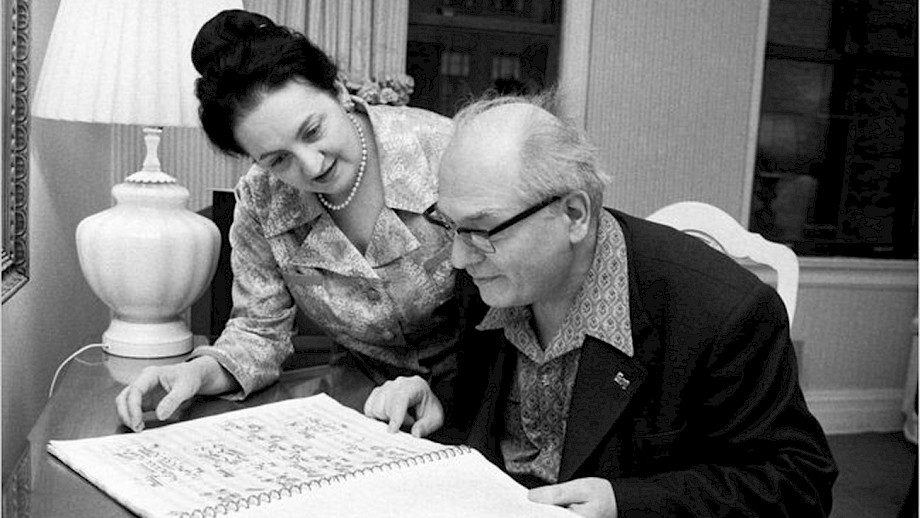
Yvonne Loriod and Olivier Messiaen (Photo: John Sotomayor, The New York Times)

And then?

She explained to me in great detail the basics of a sense of style, for example that a ritardando is not just about slowing down. All these elements - volume, tempo and so on - are levels of expression. And the only way to achieve your own interpretation with integrity is to follow the score exactly, to realise as precisely as possible what the composer wanted. She said: "If you have played this work 350 times, as I have, and really understood its fundamentals, you can achieve a certain stylistic flexibility." But imitating a recording is simply inappropriate and ultimately disrespectful.

Did Yvonne Loriod and Messiaen always agree?

There's a story about that too: We were sitting at dinner once and there was a friendly dispute between Yvonne Loriod and myself. It was about the song of the notou, a New Caledonian bird, which Messiaen had used as the leitmotif for the angel in his opera "Saint François d'Assise". I sang my understanding of this motif to her. She disagreed and sang her version, which was slightly different. We argued back and forth until Messiaen raised his hands and told us to stop, we were both wrong. He then fetched his tape recorder with the recording of the original birdsong. We could only laugh - our whole discussion had been completely absurd! Things like that happened every day.

Did you ever accompany Messiaen on one of his ornithological excursions?

Only once, that was still in the USA. Normally he and his wife didn't take anyone with them. But back then we went to a bird sanctuary north of San Francisco, where Canada herons nest. We were absolutely silent, Messiaen just listened and wrote down the birdsong in his diary. It was an unforgettable experience for me to observe Messiaen as he observed. Not only in nature, by the way.

But?

In Paris, Yvonne Loriod and I used to accompany him to the Trinité church, where he was the organist. Once there was a priest who had difficulties with an "Alleluia"; perhaps he was ill that day, but in any case his intonation was unsteady and his voice was constantly overflowing. Messiaen didn't make a face, but you could see that he was listening attentively. Later, the collection was taken and, as was customary, he first played a work - it was one by César Franck - and then bridged the rest of the time with improvisation. He then very subtly incorporated an exact imitation of the crooked "Alleluia", as well as a bird song, and everything was always based on Franck's material ... It was brilliant. Messiaen really had a lot of humour. And like all the episodes I've mentioned, this little scene also had consequences: It showed me how important it is to listen carefully and notice interesting things even where you wouldn't expect them. This realisation has stayed with me to this day.

Turangalîla Symphony

Olivier Messiaen (1908-1992) wrote this ten-movement work for orchestra, piano and Ondes Martenot, which lasts around 80 minutes, between 1946 and 1948 for the Boston Symphony Orchestra. In Sanskrit, the word "Turangalîla" refers to a specific rhythmic pattern, an Indian deçî-tâla, which Messiaen used in this symphony. The premiere on 2 December 1949 was conducted by Leonard Bernstein, with Messiaen's wife Yvonne Loriod playing the piano part. The Tonhalle-Orchester Zürich has only performed the work three times: in 1957 under the direction of Hans Rosbaud (with Yvonne Loriod at the piano), in 1988 under Hiroshi Wakasugi and in 2008 under Eliahu Inbal.

So Messiaen is still present in your work 34 years after his death?

Yes, and also very specifically: when he died, Yvonne Loriod wanted me to inherit the Bösendorfer grand piano on which many of his works were composed. When I play the piano part of the "Turangalîla Symphony" on it today, for example, I imagine the colours he heard while composing.

When you think about the performance of the "Turangalîla Symphony" in Zurich, how do you convey everything you have learnt from Messiaen to the orchestra in just one week of rehearsals?

The Tonhalle-Orchester Zürich is a great orchestra! Not just technically - the musicians are real artists, they are open and highly sensitive to the substance and content of the works. If an ensemble has technical limitations or difficulties with an unfamiliar aesthetic, preparing such a piece is a problem. But with this orchestra, respect for the score and the composer's intentions is the starting point. From there, the music develops as a natural, breathing form of communication and expression - as a sounding metaphor for community.

April 2026
Thu 16. Apr
19.30

Kent Nagano with Messiaen

Tonhalle-Orchester Zürich, Kent Nagano Leitung, Yury Favorin Klavier, Nathalie Forget Ondes Martenot Messiaen
Fri 17. Apr
19.30

Kent Nagano with Messiaen

Tonhalle-Orchester Zürich, Kent Nagano Leitung, Yury Favorin Klavier, Nathalie Forget Ondes Martenot Messiaen
published: 02.04.2026

Tags